First aid training is one of the most practical and potentially life-saving qualifications anyone can hold. Whether you work in childcare, aged care, construction, education or any customer-facing role, having current first aid skills can make all the difference in an emergency.
HLTAID011 Provide First Aid is a nationally recognised course that equips students with the knowledge and skills to respond to a wide range of emergency situations. Here's what the course covers and what you can expect if you decide to enrol.
What Is HLTAID011 Provide First Aid?
HLTAID011 is a nationally recognised unit of competency included in the Health (HLT) and Community Services (CHC) training packages. It teaches students how to assess an emergency scene, provide appropriate first aid response and communicate incident details to emergency services.
The unit is written around the first aid guidelines determined by the Australian Resuscitation Council (ARC) and other Australian national peak clinical bodies. That matters more than it sounds: it means the course content is tied to current, evidence-based Australian practice rather than a generic global standard.
The course goes beyond basic CPR. It covers a broad range of scenarios including allergic reactions, burns, fractures, choking, bleeding, shock and medical emergencies such as heart attacks and strokes.
Upon successful completion, students receive a Statement of Attainment for HLTAID011, which we recommend renewing every 3 years. CPR components within the course are recommended for refresh every 12 months to maintain currency.
HLTAID011 and the Unit It Replaced
HLTAID011 superseded HLTAID003 Provide First Aid, and the National Training Register marks it as not equivalent to that older unit. Practically speaking, this means if you're told you need "first aid certification", you should check which code is actually being asked for.
The distinction catches people out constantly. A workplace, industry body or funding program may still reference the old HLTAID003 code on paperwork written years ago. If your paperwork says HLTAID003, check with whoever issued it before you enrol, because a provider who issues HLTAID011 will not satisfy an HLTAID003 requirement.
The other thing worth knowing is what HLTAID011 does not replace. It contains CPR, but it is not the standalone CPR qualification. If you need CPR currency specifically, separately from first aid, that's HLTAID009 — and we explain the difference in detail further down.
What You'll Learn
HLTAID011 covers essential first aid knowledge and practical skills across several key areas:
- ✓Assessing emergency situations and prioritising safety
- ✓Applying appropriate first aid procedures
- ✓Using an automated external defibrillator (AED)
- ✓Managing choking, bleeding, fractures and burns
- ✓Responding to poisoning, envenomation and bites
- ✓Recognising and assisting with medical emergencies
- ✓Communicating with emergency services and documenting incidents
- ✓Understanding legal responsibilities and duty of care
The Four Elements of HLTAID011
Every unit of competency is built from a small number of elements, and each one becomes something you have to actually demonstrate. HLTAID011 has four, and they map onto the real sequence of a first aid response from start to finish. That last element is the one most people have never seen mentioned in a first aid course description, and it's deliberately included — performing CPR on a stranger, or on a colleague, can be genuinely distressing, and a quality course treats that as part of the job rather than an awkward footnote.
- ✓Respond to an emergency situation — recognise and assess what is happening, ensure safety for yourself, bystanders and the casualty, assess the casualty and recognise the need for first aid, and seek assistance from emergency services
- ✓Apply appropriate first aid procedures — perform CPR in accordance with ARC guidelines, provide first aid in accordance with established first aid principles, obtain consent from the casualty where possible, operate first aid equipment according to the manufacturer's instructions, and monitor the casualty's condition throughout
- ✓Communicate details of the incident — accurately convey incident details to emergency services, report in line with workplace or site procedures, complete applicable incident report documentation, and maintain privacy and confidentiality of the information
- ✓Review the incident — recognise the possible psychological impacts on yourself and other rescuers and seek help when required, and contribute to a review of the first aid response as required
What the Assessment Actually Involves
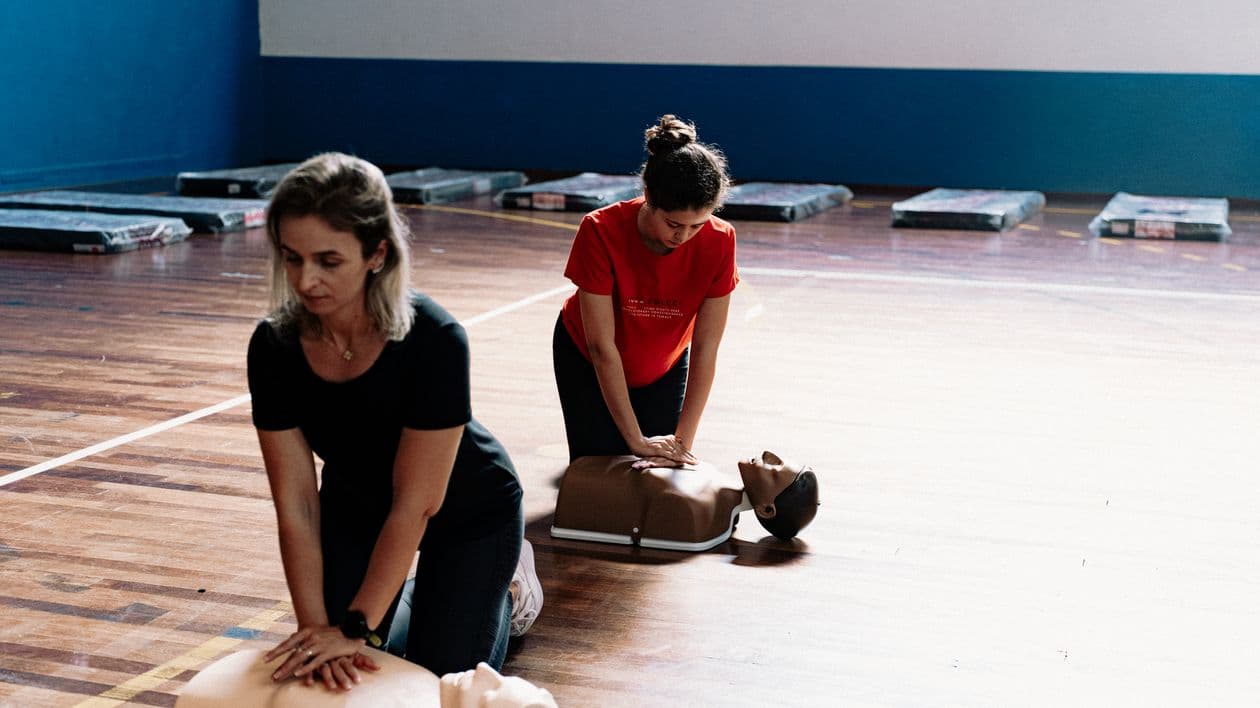
This is where most people find out that HLTAID011 is more hands-on than they expected. Under the published assessment requirements, you must demonstrate at least two minutes of uninterrupted single rescuer CPR — that's five full cycles of compressions and ventilations — on an adult manikin placed on the floor, not on a table.
You'll also be required to follow an AED's prompts through delivering at least one shock, demonstrate a rotation of single rescuer operators with minimal interruption to compressions, and perform infant CPR on an infant manikin on a firm surface. Rotation with minimal interruptions is the part people find hardest, and it's the part that matters most in real life, because compressions lose their value the moment they stop.
Beyond CPR, the practical assessment covers managing casualties with anaphylaxis, asthma, non-life-threatening bleeding, choking, envenomation using pressure immobilisation, fractures, dislocations, sprains and strains using appropriate immobilisation techniques, minor wound cleaning and dressing, nosebleeds and shock.
The assessment is genuinely scenario-based. You respond to at least one simulated first aid incident contextualised to your own workplace or community setting, where you have no prior knowledge of the casualty's condition. You identify the problem through history, signs and symptoms, use appropriate PPE, provide treatment, convey incident details to emergency services, and produce an accurate verbal and written report of what happened.
You'll be assessed on manikins, never on a live person. Every provider is required to have adult and infant manikins, AED training devices, an adrenaline auto-injector training device, a placebo bronchodilator and spacer, dressings and bandages, and incident report forms available on the day.
Course Structure and Assessment
At Cardinal Institute, HLTAID011 runs in blended mode: three hours of face-to-face training combined with an online assessment component. The Statement of Attainment is issued the same day you complete it.
Assessment includes a written component delivered online, plus the practical demonstrations and scenario-based assessment required to demonstrate competency. Students must demonstrate CPR on a manikin and work through at least one simulated first aid incident contextualised to their own workplace or community setting, producing both a verbal and a written report of what happened.
We cover a wider range of practical needs — if you have requirements around mobility, access or assessment arrangements, contact us before you enrol and we'll talk it through.
Who Should Take This Course?
HLTAID011 is suitable for anyone who wants to be prepared for emergencies, but it is particularly relevant for people in roles where first aid certification is a workplace requirement:
- ✓Childcare and education workers
- ✓Aged care and disability support workers
- ✓Construction and trades workers
- ✓Fitness instructors and sports coaches
- ✓Hospitality and retail staff
- ✓Parents and community volunteers
- ✓Anyone wanting confidence to help in emergencies
HLTAID011 or HLTAID009 — Which One Do You Need?
This is the most common question we get asked, and the answer depends entirely on what your employer, industry or funding body has asked for.
HLTAID011 Provide First Aid is the broad qualification. It covers the full range of first aid response — bleeding, burns, fractures, choking, shock, medical emergencies — and it includes CPR as one component. If someone has said you need first aid certification, this is almost always what they mean.
HLTAID009 Provide Cardiopulmonary Resuscitation is the narrow one. It focuses almost entirely on CPR and the AED, and because that's all it covers, it's shorter and needs refreshing more often.
A lot of employers accept either one, or accept both together, but the responsibility for getting it right sits with the person doing the enrolling. Here's the short version. We publish both units on this site so you can compare them properly — you can read the full breakdown of HLTAID009 alongside this guide.
- ✓You're told you need "first aid" or HLTAID011 → take HLTAID011
- ✓You're told you need CPR currency, or your industry requires annual resuscitation training → take HLTAID009
- ✓You're told you need both → take both, and ask whether they can be completed on the same day
- ✓You're completing it for a job you already have and you're unsure → ask your manager, or check your employment agreement in writing, before you pay for anything
Why First Aid Training Matters
In a medical emergency, the first few minutes are critical. Having trained first aiders in workplaces, schools and community settings can significantly improve outcomes for people experiencing injury or sudden illness.
Beyond the practical skills, first aid training builds confidence and reduces panic in high-pressure situations. Students learn to stay calm, assess risks and take appropriate action until professional help arrives.
Many Australian states and territories also have legal requirements for workplaces to have a certain number of trained first aiders on site, making this certification both a personal and professional asset.
In New South Wales, the Work Health and Safety Act 2011 and the associated Safe Work Australia code of practice set the standard: a person conducting a business or undertaking must ensure appropriate first aid arrangements are in place, which in practice means suitable facilities, equipment and trained people for the size and risks of the workplace.
That regulatory backdrop is the reason first aid training keeps showing up in job descriptions, risk assessments and tender applications. It's not bureaucracy for its own sake — it's the law reflecting the fact that the minutes before an ambulance arrives are usually handled by whoever happens to be standing there.
Certificate Validity and Refresher Requirements
The HLTAID011 Statement of Attainment is recommended for renewal every 3 years from the date of issue. However, the Australian Resuscitation Council recommends that CPR skills be refreshed every 12 months, and our HLTAID009 course covers that.
Many training providers offer refresher courses to help students maintain their skills and stay up to date with current first aid guidelines. Keeping your certification current ensures you're always ready to respond effectively.
Choosing the Right Training Provider
When selecting a provider for HLTAID011, it's important to consider a few key factors:
- ✓Is the training delivered by qualified and experienced trainers?
- ✓Does the course include hands-on practical components?
- ✓What is the student-to-trainer ratio during practical sessions?
- ✓Are flexible scheduling options available?
- ✓Is the training provider a registered training organisation (RTO)?
Final Thoughts
HLTAID011 Provide First Aid is a practical, nationally recognised qualification that gives students the skills and confidence to respond to emergencies in any setting.
Whether you need this certification for your workplace or simply want to be prepared to help those around you, it's a course that delivers real value.
Contact Cardinal Institute of Education to find out more about upcoming HLTAID011 course dates, delivery options and enrolment requirements.
Interested in HLTAID011 Provide First Aid?
Explore our HLTAID011 Provide First Aid course and discover your study options.